 English



Tel : +86 13729892225
Email : export@dtechelectronics.com










Tel : +86 13729892225
Email : export@dtechelectronics.com
Smart Parking Network Solution
Industrial Ethernet Switch Solution for Smart Parking Systems
Smart parking infrastructure demands network equipment that performs reliably in underground garages, outdoor lots, and EV charging environments — despite humidity, temperature extremes, and power instability. This guide explains how to architect a resilient parking network using industrial-grade Ethernet switches.
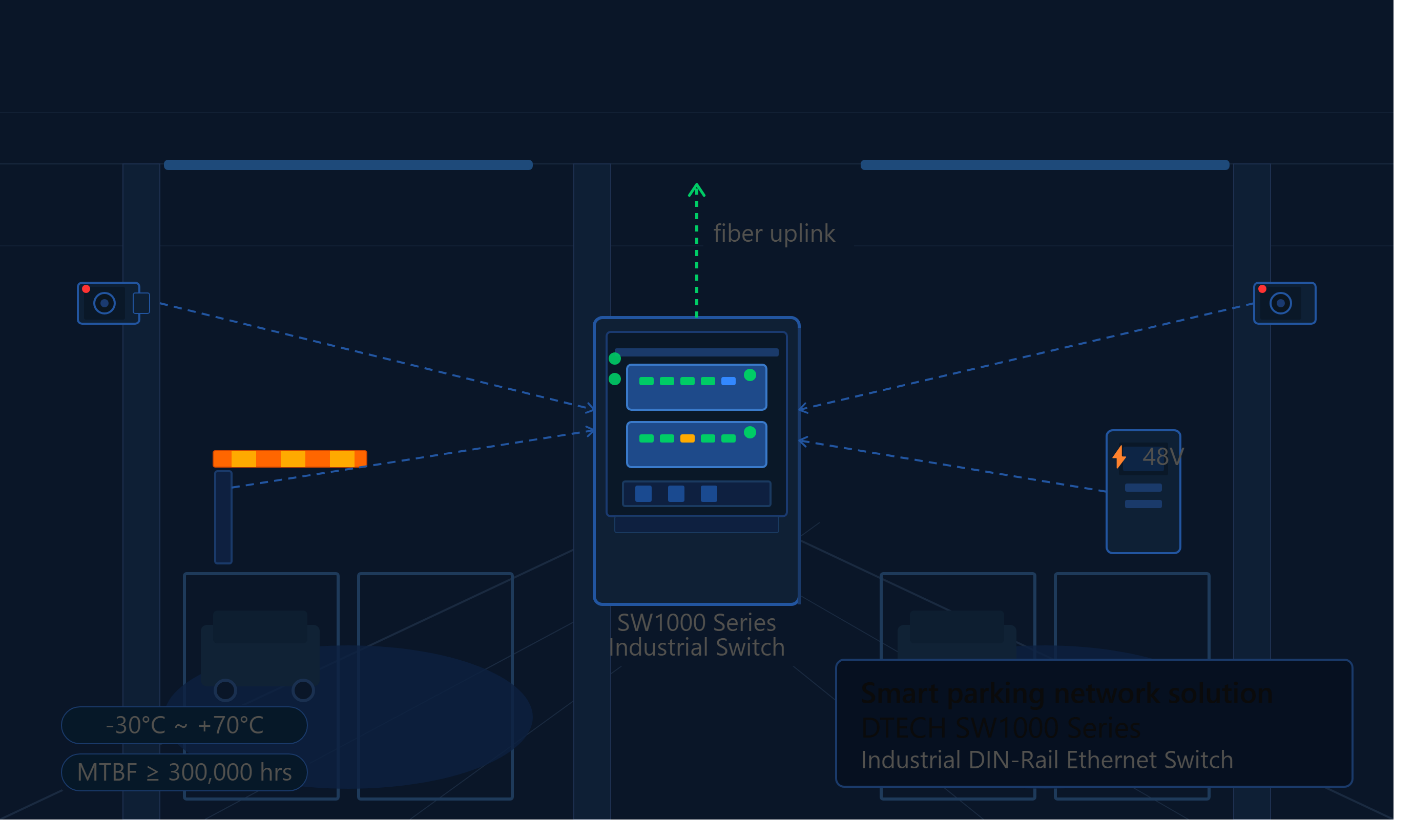
Why Smart Parking Needs Industrial-Grade Networking
Modern smart parking systems are no longer simple barrier-and-ticket operations. Today's facilities integrate license plate recognition (LPR) cameras, ground sensors, automated barriers, self-service payment terminals, EV charging station controllers, and real-time guidance displays — all of which depend on a stable, always-on network to function.
The problem is that most of this equipment is installed in environments that consumer or commercial-grade network switches were never designed for. Underground garages are damp, cold, and chemically corrosive. Outdoor surface lots see temperature swings from well below freezing in winter to over 60°C inside roadside cabinets in summer. Power quality in parking facilities is often poor, with voltage fluctuations caused by high-current EV chargers and elevator motors cycling on and off.
When the network goes down in a parking facility, the consequences are immediate and visible: barriers freeze in place, cameras lose their feed, payment terminals go offline, and vehicles get trapped or access is left uncontrolled. This is why parking network infrastructure demands industrial-grade switches built for continuous unattended operation — not office-grade equipment pressed into field service.
A 30-minute network outage at a busy urban parking facility can trap hundreds of vehicles and generate significant liability. Industrial switches rated for 300,000+ MTBF hours pay for themselves by eliminating these incidents.
Environmental and Operational Challenges
Temperature Extremes
Underground parking garages maintain relatively stable temperatures year-round (typically 5°C–25°C), but the electrical cabinets mounted on concrete pillars can experience condensation and cold starts in winter. More demanding are outdoor rooftop and surface lots, where roadside control cabinets can reach internal temperatures exceeding 65°C in summer sun exposure. Standard commercial switches typically carry an operating range of 0°C–40°C — insufficient for either extreme.
Power Quality and Continuity
Parking facilities share power infrastructure with high-load equipment: lifts, ventilation fans, and increasingly, EV charging stations drawing 7–150 kW per point. This creates voltage sag, transient spikes, and switching noise on the supply rail. A network switch without hardware-level reverse polarity protection and broad input voltage tolerance will experience frequent resets or permanent damage under these conditions.
Electromagnetic Interference
EV chargers, variable-frequency drives in ventilation systems, and vehicle ignition systems generate significant electromagnetic noise. Without industrial-grade EMC protection, network ports on ordinary switches experience packet errors, link drops, and hardware degradation over time.
Physical Access and Maintenance Cost
Network equipment in parking facilities is distributed across many physical locations — every entrance, every payment kiosk zone, every camera cluster. Each on-site service visit requires dispatching a technician to a specific underground or outdoor location. Equipment with a short MTBF or that requires firmware management drives up operational cost substantially over a facility's 10–20 year lifecycle.
Recommended Network Architecture
A well-designed smart parking network uses a three-layer topology that mirrors how the physical facility is organized:
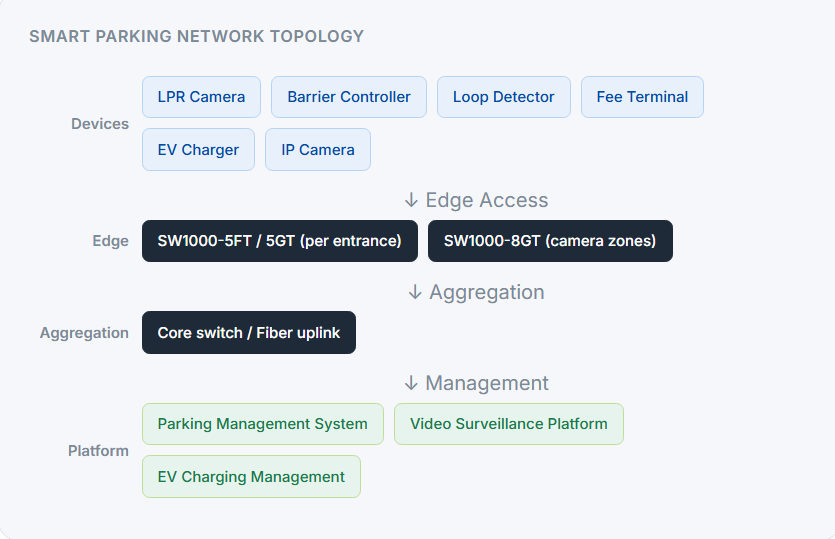
SW1000 switches are deployed at the edge access layer — installed inside the electrical cabinet at each entrance, each camera cluster zone, and each EV charging bay group. Their role is to aggregate all the field devices in their immediate zone and uplink to the facility's core switch via Cat6 or fiber. Because SW1000 switches are unmanaged, there is no configuration required: they forward traffic at line rate the moment they are powered on.
Deployment Scenarios in Detail
Entrance and Exit Control Units
Each vehicle entrance or exit lane typically requires connectivity for: one or two LPR cameras, one barrier controller, one ground loop detector or radar sensor, and one intercom or emergency call unit. This is 4–5 devices per lane, making the SW1000-5FT-BU-2D the optimal fit — it provides exactly enough ports for a standard lane without overpaying for unused capacity.
For facilities with a dual-lane entrance (two inbound + one outbound), a single SW1000-8FT-BU-2D can consolidate both lanes and their associated devices into one cabinet-mounted switch, simplifying wiring and reducing cabinet size.
Single-lane entrance
SW1000-5FT: LPR camera + barrier controller + loop detector + intercom + uplink. Zero spare ports wasted.
Dual-lane entrance / exit
SW1000-8FT or 8GT: consolidate both lanes. One switch per cabinet, one uplink cable to core.
Self-service payment zones
SW1000-5FT per kiosk cluster: payment terminal + reverse-lookup display + local camera + uplink.
EV charging bay networks
SW1000-8GT: up to 7 charger controllers + uplink. Gigabit ports handle concurrent telemetry from fast-chargers.
Surveillance Camera Networks
High-definition IP cameras at 4K resolution require 8–25 Mbps per stream. A parking floor with 8 cameras running H.265 at 4K generates roughly 100 Mbps of video traffic — well within the capacity of a single SW1000-8GT-BU-2D with its 16 Gbps non-blocking switching fabric. The Gigabit uplink port ensures video reaches the NVR or cloud platform without congestion.
For underground floors with limited fiber routing, each floor can have its own SW1000-8GT aggregating all cameras, with a single fiber run to the surface aggregation switch. This star-per-floor topology eliminates long horizontal cable runs and simplifies fault isolation.
EV Charging Infrastructure
EV charging stations introduce a unique networking challenge: they generate significant harmonic distortion and switching transients on both power and data lines as high-current contactors open and close. The SW1000's network port surge protection of 2 kV common-mode and ESD rating of ±8 kV provides adequate protection against these transients without requiring additional surge protectors at each port.
Always run data cables for charging station controllers in separate conduit from power cables. Even with SW1000's robust EMC protection, maintaining physical separation between high-current AC wiring and network cabling is a best practice that reduces interference and simplifies future maintenance.
Why the SW1000 Series Fits This Application
Model Selection Guide
Choosing the right SW1000 variant depends on two factors: the number of devices to connect and the bandwidth requirement of those devices.
SW1000-5FT-BU-2D — Standard single entrance lane. Barrier + LPR + 2 sensors + uplink. 100 Mbps ports are sufficient for barrier control and SD cameras.
SW1000-8FT-BU-2D — Dual-lane entrance or mixed device zones. Up to 7 field devices + uplink. Use where camera resolution is 1080p or below.
SW1000-5GT-BU-2D — Compact 5-port Gigabit. Ideal for EV charger groups (up to 4 chargers + uplink) or 4K camera pairs requiring Gigabit throughput.
SW1000-8GT-BU-2D — 8-port Gigabit. Best for multi-camera floors, large EV charging bays, or any zone requiring future-proof Gigabit headroom. 16 Gbps switching capacity handles worst-case concurrent load.
For most new parking facilities: deploy SW1000-5FT at each entrance lane, SW1000-8GT at each camera zone floor, and SW1000-5GT at EV charging clusters. This configuration optimizes cost while providing Gigabit capacity where bandwidth matters most.
Installation and Commissioning
The SW1000 series is designed for installation inside standard roadside or pillar-mounted electrical cabinets on a DIN-35 rail. The installation process requires no special tools beyond a screwdriver and takes under 10 minutes per unit:
1. Mount the switch on the DIN-35 rail inside the cabinet — clip fits securely with a single press.
2. Connect the 3-pin power terminal block to the cabinet's DC supply (12V, 24V, or 48V). Connect V+ and V− correctly; polarity protection prevents damage from accidental reversal but correct connection is always recommended.
3. Connect the FG (earth) wire to the cabinet's protective earth. This activates the full surge and ESD protection capability.
4. Plug in field device cables and the uplink cable. The switch auto-negotiates speed, duplex, and cable polarity on all ports.
5. Verify green LED indicators on all connected ports. No software configuration is required.
Because the SW1000 is unmanaged, there is no IP address to assign, no VLAN to configure, and no firmware to update. This makes it ideal for deployment by field technicians without network engineering expertise — a significant operational advantage when rolling out across dozens of entrances simultaneously.
Frequently Asked Questions
1. What type of Ethernet switch is best for a smart parking system?
▾
An industrial-grade unmanaged DIN-rail Ethernet switch with wide operating temperature, redundant power input, and surge protection is best suited for smart parking environments. The DTECH SW1000 Series meets all these requirements with an operating range of -30°C to +70°C, dual DC 12–52V inputs, and ESD protection up to ±8 kV. Unmanaged switches are preferred in parking applications because they require no configuration and eliminate the risk of misconfiguration causing downtime.
2. How many ports does a parking lot network switch need?
▾
A single parking entrance typically requires 4–6 ports: one for the barrier controller, one or two for LPR cameras, one for the loop detector or radar sensor, one for the intercom or fee terminal, and one uplink port. The SW1000-5FT covers a standard single lane. For dual-lane entrances or camera-heavy zones, the SW1000-8FT or 8GT provides the necessary port density.
3. Can industrial switches operate in underground parking garages?
▾
Yes. The DTECH SW1000 Series is rated IP40, operates from -30°C to +70°C, and uses fanless passive cooling — making it well suited to the humid, cool, and dusty conditions typical of underground parking structures. The metal housing prevents moisture ingress and provides physical durability against the occasional mechanical contact that occurs in maintenance environments.
4. Will EV chargers interfere with the parking network switch?
▾
EV chargers generate electromagnetic noise and voltage transients that can damage standard network equipment. The SW1000's network port surge protection (2 kV common-mode) and ESD protection (±8 kV air discharge) are specifically designed to absorb these transients without data corruption or hardware damage. Running data cables in separate conduit from power wiring is also recommended as a complementary measure.
5. Do I need to configure the switch before installation?
▾
No. The SW1000 Series is an unmanaged switch that requires zero configuration. It auto-negotiates port speed, duplex mode, and cable polarity the moment devices are connected. Simply mount on the DIN rail, connect power, and plug in devices — the network is operational immediately.
Previous :
DTECH Intelligent Traffic SolutionNext :
DTECH USB Industrial Serial Cable© Copyright: 2026 Guangzhou Dtech Electronics Technology Co.,Ltd. All Rights Reserved.

